
Market Analysis · April 2026
Where senior cannabis professionals go to build the relationships that matter — and why the European networking environment is structurally different from anything operating in North America.
Key Findings
- North American cannabis is mature, capital-constrained, and predominantly domestic in its networking logic; European cannabis is earlier-stage, regulatory-velocity-driven, and requires country-by-country relationship architectures that no single trade show can substitute for.
- The most consequential B2B relationships in European cannabis in 2026 involve regulators, clinical researchers, and healthcare system stakeholders — categories that are largely absent from North American industry events.
- In-person relationship-building remains structurally essential in cannabis: regulatory sensitivity, banking complexity, and the due diligence demands of cross-border deals make professional trust the prerequisite for commercial conversation.
- The relationship capital built in European cannabis during 2025–2026 will determine who participates in the deals that close in 2026–2028, when regulatory milestones in Germany, the UK, and France translate into significant commercial transactions.
Two Poles of Global Cannabis Business
Global cannabis business in 2026 divides along a clear axis. North America — the US and Canada — represents the mature pole: a market with decade-long legal commercial infrastructure, significant capital formation history, and a sophisticated operator and supplier ecosystem. Europe represents the growth pole: earlier-stage by design, operating under pharmaceutical rather than consumer regulatory frameworks, and moving at a regulatory velocity that is simultaneously frustrating and — for patient investors and operators — extraordinarily compelling.
Understanding the structural difference between these two poles is not merely geographic curiosity. It has direct implications for where senior B2B cannabis professionals invest their time, travel budget, and relationship-building effort. A conference strategy optimised for the North American market produces a materially different outcome to one designed for European opportunity capture. The two approaches are not interchangeable.
This analysis compares the markets as they stand in 2026 — their regulatory states, capital environments, networking infrastructure, and the specific relationship types that produce commercial outcomes in each — and draws conclusions about where to focus for professionals operating across both geographies.
Market Maturity: Where Each Region Stands
North America
Mature, Fractured, Capital-Constrained
- 39+ US states with some form of legal cannabis access
- DEA Schedule III federal rescheduling under active review
- Banking access improving incrementally via SAFE Banking advocacy
- Canadian LPs restructuring after market over-supply and price collapse
- US multi-state operators (MSOs) focused on profitability over growth
- Mature supplier ecosystem: technology, packaging, testing, logistics
Europe
Earlier Stage, Regulatory Velocity, Pharma Model
- 30+ jurisdictions at varying regulatory stages
- Germany's CanG (April 2024) as the watershed regulatory event
- Medical cannabis fully pharmaceutical-grade across key markets
- Adult-use at pilot stage: Switzerland, Luxembourg, Malta, Netherlands
- EU single market does not apply — country-by-country frameworks
- Prescription volumes growing rapidly in Germany and the UK
The North American market's maturity is both its strength and its constraint. Established operators have built efficient commercial infrastructure — distribution networks, brand recognition, retail relationships, supply chain discipline. But the capital markets correction of 2022–2024 left many operators focused on survival rather than growth, and the investor appetite for new cannabis ventures, absent federal legalisation clarity, remains suppressed relative to the 2021 peak.
Europe's earlier-stage profile creates a different kind of opportunity. The European cannabis regulatory landscape is complex precisely because it is still being written. The relationships formed during the norm-setting period — with the regulators drafting frameworks, the clinicians designing prescribing pathways, the investors building the institutional infrastructure — are the most durable competitive advantages in the European market. Those relationships are built in person, at events and in working groups where professional trust is established over shared work rather than transactional exchange.
Further Reading
The B2B Networking Landscape
Where do senior cannabis professionals actually go to build the relationships that produce deals? The conference and events landscape in each geography reflects the market's underlying character.
North America: Scale, Breadth, Operational Depth
USA — December, Las Vegas
MJBizCon
The world's largest cannabis trade show. Approximately 30,000 attendees, thousands of exhibitors, and comprehensive supplier and operator representation. Indispensable for US market intelligence and vendor relationship-building. Limited European regulatory depth.
USA — Various
Benzinga Cannabis Capital Conference
Investor-focused format with structured CEO pitches and one-to-one meetings. Strong for North American capital formation introductions and public-market cannabis investor access.
Canada
Cannabis Canada Conference
The primary Canadian industry forum, reflecting the LP-dominated structure of the Canadian market. Relevant for Canadian regulatory developments and LP relationship-building.
MJBizCon's scale is genuinely impressive, and for any professional building North American cannabis relationships it remains an essential annual engagement. The show's breadth — from licensed producers and multi-state operators to ancillary technology companies, testing laboratories, and real estate specialists — reflects the depth of commercial infrastructure that 15 years of legal cannabis has built in the US. For understanding the state of the North American market, there is no substitute.
Its limitation for European-focused professionals is equally genuine. MJBizCon's regulatory content is overwhelmingly US-centric, its investor relationships are calibrated to US market dynamics, and the regulatory frameworks that govern European pharmaceutical-grade cannabis operate in a fundamentally different universe to US state licensing regimes. Attending MJBizCon to build a European cannabis network is the wrong tool for the job.
Europe: Regulatory Depth, Cross-Border Deal-Making
UK — 26–27 May 2026, London
Cannabis Europa
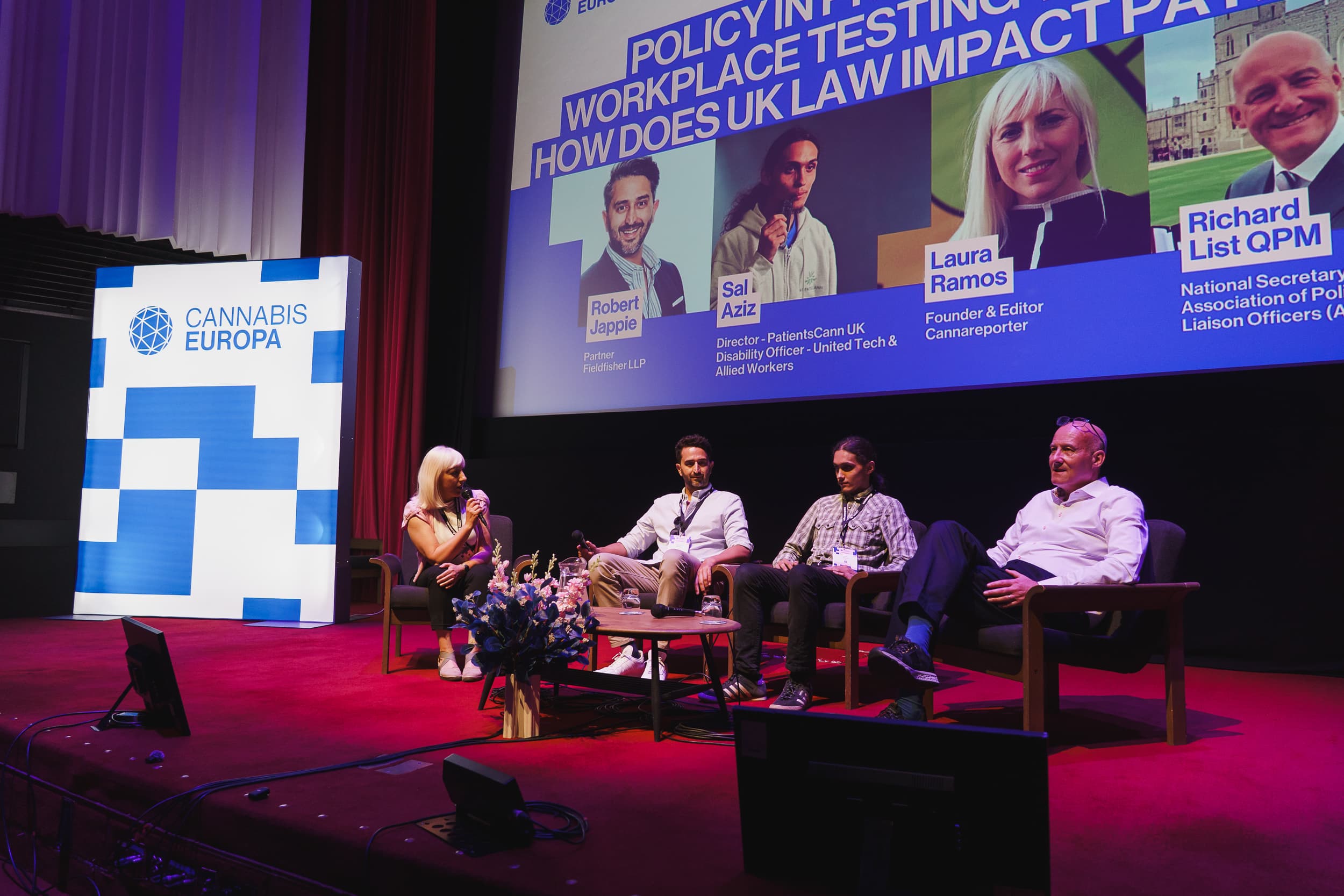
Europe's leading policy and business forum. Regulators, institutional investors, C-suite operators, and clinical researchers. Explicitly designed for cross-border European deal-making and policy dialogue. The Barbican, London.
Germany — Berlin
ICBC Berlin
International Cannabis Business Conference. Larger exhibitor base than Cannabis Europa, broader industry coverage. Strong for supplier relationship-building and broader European industry intelligence.
Switzerland
CannaTrade
Swiss-focused cannabis event with relevance for the evolving Swiss regulatory pilot programmes. Useful for Switzerland-specific regulatory and business development relationships.
Europe — Various
Cannabisville
Consumer-adjacent positioning. Less relevant for senior B2B relationship-building; useful for retail and consumer product market intelligence.
The Audience Gap: What the Numbers Miss
The comparison between MJBizCon's approximately 30,000 attendees and Cannabis Europa's more concentrated format invites a category error. Conference scale and conference value are distinct variables. The relevant metric for B2B relationship-building is not total attendance but the density of decision-makers — the proportion of attendees with the authority and intent to initiate deals, partnerships, regulatory conversations, or investment relationships.
Cannabis Europa is designed from the floor plan outward to maximise that density. Regulators from European health ministries and national agencies attend not as observers but as active dialogue participants. Institutional investors attend because the event provides concentrated access to the operator and policy relationships their due diligence requires. C-suite executives attend because the structured programme addresses the regulatory and commercial questions that define their strategy — not the operational detail that dominates trade show agendas.
The result is an event where the networking value per conversation is substantially higher than at general-market trade shows. That ratio matters disproportionately at a moment in European cannabis development when the relationships being built in 2026 will determine deal participation in 2027 and beyond. Read more on why attending a cannabis business conference in 2026 matters for your strategy.
Why European B2B Networking Is Structurally Different
Three structural features of the European cannabis market distinguish its networking requirements from the North American model.
Regulatory Relationships Are Competitive Advantage
In the US, regulatory relationships matter at state level and through lobbying at federal level. But the US cannabis market has enough established infrastructure that operators can build commercially viable businesses without direct access to regulators — licensing processes are well-documented, legal advisers are experienced, and the precedents are extensive. In Europe, where frameworks in France, Germany, the Netherlands, and other jurisdictions are still being designed, the organisations participating in policy consultation are shaping the rules that everyone else will operate under. Being in those conversations is a durable first-mover advantage. The policy battles defining European cannabis in 2026 are being contested partly in these working-group contexts.
Country-by-Country Relationship Architecture
The EU single market applies to goods, services, and capital — but explicitly not to cannabis, which each member state regulates under its own national competence. An operator with strong relationships in Germany has not thereby built a network in France, Spain, or Italy. Each jurisdiction requires its own relationship architecture: national health authority contacts, physician networks, pharmacy distribution relationships, legal counsel with specific national regulatory expertise, and policy engagement with national government stakeholders. A European cannabis strategy is therefore not one network but six or eight overlapping country-specific networks. The European cannabis hub and individual country pages for Germany, France, Spain, and Italy provide the regulatory context for each market.
Pharmaceutical Adjacency as a Networking Category
European cannabis-based medicinal products are regulated as pharmaceuticals. That means the relevant professional community extends far beyond the cannabis industry narrowly defined. Pharmaceutical executives evaluating CBMP as a product category adjacency, MHRA and EMA scientific advisers with insight into the regulatory standards that will govern future cannabis medicines, clinical researchers generating the outcomes data that drives prescribing behaviour, and hospital formulary decision-makers whose inclusion decisions can transform a product's commercial trajectory — all of these stakeholders are standard participants in European cannabis networking at the senior level. They are not typically found at North American cannabis trade shows.
The Investor Networking Opportunity
European cannabis investment is at an earlier stage than its North American equivalent. That asymmetry has a specific implication for relationship-building: the investor relationships being established in European cannabis in 2025 and 2026 are not primarily about closing deals that exist today. They are about building the trust, the deal-flow access, and the information advantage that will determine participation in the transactions that close in 2027 and 2028, as German Pillar 2 legislation progresses, UK CBMP market depth increases, and Swiss pilot data potentially catalyses adult-use investment activity.
Investors who wait until regulatory frameworks are fully settled to begin building European cannabis relationships will find themselves competing for deals against operators who have had two or three years of relationship-building advantage. The current environment — where regulatory frameworks are being written and the investor community is smaller and more accessible — is precisely when relationship capital is most efficiently accumulated.
The European cannabis investment analysis for 2026 covers the investor type landscape and the specific sectors attracting active capital deployment.
Digital vs. In-Person: Why Cannabis Remains a Handshake Industry
Cannabis has not followed the trajectory of industries where digital networking has substantially displaced in-person relationship-building. Several structural features conspire to maintain the primacy of face-to-face engagement.
Regulatory sensitivity is the most important. Conversations about licensing strategy, regulatory compliance, investment structure, and commercial distribution terms in cannabis carry sensitivities that make public platforms unsuitable. LinkedIn is an effective broadcast channel for thought leadership and connection initiation, but the substantive conversations that produce commercial relationships happen in settings where confidentiality is understood and professional context is shared.
Banking complexity adds a further dimension. In cannabis — more than in most industries — the financial relationships underpinning commercial deals are themselves the subject of careful negotiation and trust-building. Counterparties in cannabis transactions apply heightened due diligence to their commercial relationships because the consequences of association with non-compliant operators can be severe. That due diligence process runs on personal trust, which is most efficiently built in person.
The result is that the cannabis industry, despite being thoroughly digital in its consumer-facing operations, remains fundamentally relationship-driven at the B2B level in ways that make in-person event participation a genuine strategic investment rather than a discretionary travel expense. The analysis of commercial dynamics in European cannabis illustrates how deal-making flows through networks built at these events.
Event Comparison: At a Glance
| Event | Location | Audience Profile | Best For | European Regulatory Depth |
|---|---|---|---|---|
| Cannabis Europa | London, UK | Regulators, investors, C-suite, clinical researchers | European deal-making, policy dialogue, investor access | High — by design |
| MJBizCon | Las Vegas, USA | US operators, suppliers, investors, ~30,000 attendees | North American market intelligence, vendor relationships | Low |
| ICBC Berlin | Berlin, Germany | Broad European industry, exhibitors, operators | European supplier relationships, industry intelligence | Moderate |
| Benzinga Cannabis | USA | Investors, CEOs, capital markets | North American capital formation introductions | Low |
| CannaTrade | Switzerland | Swiss industry, regulators, researchers | Swiss pilot programme relationships | Moderate — Swiss-specific |
| Cannabis Canada | Canada | Canadian LPs, investors, regulators | Canadian market intelligence and LP relationships | Low |
How to Build a European Cannabis Network in 2026
For professionals entering or deepening their engagement with the European cannabis market — whether as investors, operators, service providers, or policy stakeholders — a systematic approach to network-building is more efficient than ad hoc conference attendance.
- Prioritise Cannabis Europa London: The single highest-return investment for European cannabis relationship capital. Two days at The Barbican on 26–27 May 2026 — structured programme, concentrated decision-maker access, and the networking density that comes from a curated attendee base. Register here.
- Join sector-relevant trade associations: Cannabiswirtschaft (Germany), UKCTA (the UK Cannabis Trades Association), and the European Industrial Hemp Association (EIHA) each provide working-group access where relationships with regulators and peer operators are built over sustained engagement rather than conference interactions. These are not passive memberships — active participation in consultations and working groups is where the relationship value lies.
- Engage national regulatory working groups: Health ministry consultation processes in Germany, France, and the UK actively seek industry input on framework design. Organisations that participate in these processes build relationships with civil servants and agency officials that have no equivalent in a conference setting. In a market where regulatory relationships are competitive advantage, this is high-return engagement.
- Develop a country-specific relationship map: Identify the ten to 15 relationships that matter most in each target jurisdiction — by role, not by name — and build systematically toward those relationships. This means national health authority scientific advisers, leading prescribing clinicians, dominant pharmacy network relationships, and the two or three investors most active in that market.
- Use LinkedIn as a signal, not a substitute: LinkedIn is an effective tool for establishing professional presence, distributing thought leadership, and initiating conversations that move to in-person settings. It is not a substitute for the substantive conversations that produce commercial relationships. Use it to amplify your conference and working-group presence rather than to replace it.
- Attend ICBC Berlin for supplier intelligence: ICBC Berlin's broader exhibitor base makes it useful for understanding the European supply chain landscape, identifying potential partners, and building relationships with operators across multiple jurisdictions in a single geography.
For businesses based in North America seeking to enter or scale in the European market, the relationship architecture described above requires a European presence — not necessarily a physical office in the first instance, but a European-based business development or regulatory affairs professional who can sustain the continuous engagement that builds genuine relationships. Quarterly visits from a North American headquarters do not produce the same relational depth as consistent local presence.
Event — 26–27 May 2026 — The Barbican, London
Cannabis Europa London 2026
Europe's leading policy and business forum. Two days of senior-level dialogue, structured networking, and cross-border deal access.
Register Your Place